Showing posts with label Finance. Show all posts

Wednesday, February 18, 2009

Little Lance Still Needs a Forever Home

Remember Little Lance...?

Adopt Little LanceAlthough I don't see the update on Friends of the Oakland Animal Shelter's site, I received a donor newsletter stating that Little Lance is still available for adoption. As a spinal injury victim, he has special needs, but if interested contact: oaklandsanimals@yahoo.com.
Also, despite the 15K reward, they still haven't caught the abusers.

In other completely unrelated news...
I've received some rather interesting mail regarding a HELOC I've never used:
"Because your account is in good standing you will receive a $200 Visa Gift Card as a bonus when you choose to close your account. It is just a way of saying thanks for your great handling of your account, and giving a little extra cash to spend any way you like."
Why would they want to pay me to close my account? That never happens with credit cards.
WTF?

Tuesday, July 29, 2008

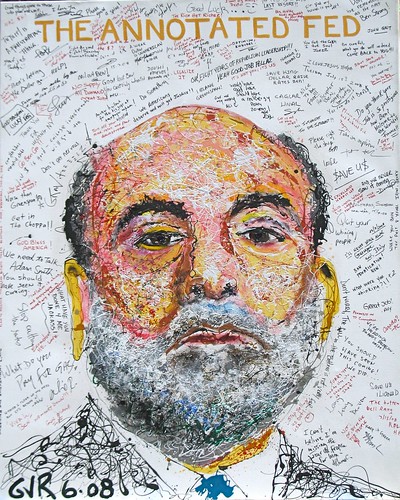
Bernanke and Hard-Drinking Shrews


The Annotated Fed


Hat tip to Wagga for this find:
A tropical shrew with a taste for alcoholic nectar has been identified as the hardest-drinking creature in the world.

Pentailed tree shrews have such an appetite for alcohol that each night they imbibe, weight for weight, the equivalent of a human downing up to nine glasses of wine...

Allen Ginsberg poetic redux for WALNUTS via Wonkette comment:
Neilist says at 4:50 pm, July 27th, 2008
- ReplyA SUPERMARKET IN LIMBO
[With Apologies to Allen Ginsberg]

What thoughts we have of you tonight, Oh WALNUTS!, as
you walk down Aisle 6, under the canned goods, with a headache
self-consciously looking at Barack’s news coverage.

In your hurt and spleen, shopping for ANY image, you went
into this neon fruit supermarket, dreaming of your enumerations!

What speeches and ellucidations! Whole families
running in fright! Aisles full of apple sauces! Wives who are soccer moms;
your black babies in their arms! — and you, Barry Goldwater, what
were you doing down by the watermelons?

We saw you, WALNUTS!, voteless, lonely old grubber,
poking among the meats in the refrigerator, looking for your favorite mastodon cutlets,
and eyeing the Electorials.

We heard you asking questions of each: Who killed McCain-Feingold?
What price compromise? Are you my next ex-wife?

We wandered in and out of the brilliant stacks of cans
following you, and followed in our imagination by Federal Election Commission detectives.

We strode down the open corridors with you in your solitary fancy,
stroking lobbyists, evangelicals, possessing every K Street dollar, and still your budget was in arrears.

Where are we going, O WALNUTS? The doors close in
November. Which way does Joe Liebermann point you tonight?

(We touch your campaign biography and feel absurd. Did you really
shoot down five of your own planes?)

Will you walk all night through solitary streets? The
voters are gone, John; lights out in the houses: you’ll be
lonely.

Will you stroll dreaming of the lost America of love
past blue automobiles in driveways, home to our silent cottage?

Ah, “Flags Of Our Fathers,” graybeard, lonely old Tokyo Rose-broadcaster,
what America did you have when your Admiral daddy and granddaddy quit poling your ferry,
and you got out on a smoking bank of your first marriage and
stood watching the boat disappear on the black waters of your reputation?

Los Angeles, 2008

[That started out funny, but it took kind of a nasty twist there at the end.]

Out of Time update!

Tuesday, July 15, 2008

Keating Five and the S&L Crisis


BREAKING NEWS UPDATE!
We almost forgot about
Tentacle Tuesday!

Since this doesn't seem to be getting enough coverage in the interwebs I thought I'd throw this historical reminder out there before returning to doggy blogging.
Here's one of the 5 politicos

who played a role in (Wiki entry below):
The U.S. Savings and Loan crisis of the 1980s and 1990s was the failure of 747 savings and loan associations (S&Ls) in the United States. The ultimate cost of the crisis is estimated to have totaled around USD$160.1 billion, about $124.6 billion of which was directly paid for by the U.S. government -- that is, the U.S. taxpayer, either directly or through charges on their savings and loan accounts-- [1], which contributed to the large budget deficits of the early 1990s. The resulting taxpayer bailout ended up being even larger than it would have been because moral hazard and adverse-selection incentives compounded the system’s losses. [2]
The concomitant slowdown in the finance industry and the real estate market may have been a contributing cause of the 1990-1991 economic
recession. Between 1986 and 1991, the number of new homes constructed per year dropped from 1.8 million to 1 million, the lowest rate since World War II. [3]

Perhaps because I love nice hotels and being on vacation, I'm thinking of Paul Auster's Hotel Existence for now.

Monday, July 14, 2008

One dollar koi and such

One dollar koi_new ver. side by *orudorumagi11
Other than a brief perusal of the NYT, I've been offline and fallen behind on my regular level of info-saturation. As I make up for lost time, I thought Mitchell’s recent comment was well worth highlighting for further discussion:
Mitchell said...
Pardon me for being boring but I'd like to brood aloud on this GSE bailout thing for a moment. It's all good; half the effect here comes from the conjunction of koi-eating octopi and mortgage securitization, right? So someone has to step up and post a comment as if this were just another housing-bubble econoblog. (Actually, it's just a lot more fun to talk about this stuff here than at the more serious places.)

So, at first it sounds bigger than subprime, much bigger. You have these two New-Deal-era institutions which own or securitize half the country's mortgages, $6trn worth. Those are their assets; but their liabilities, in the form of promised payments to bondholders,
are just as big. And since housing prices are still falling, the value of their assets will shrink, and their balance sheets will end up massively in the red - which may add several trillion more dollars to the already huge ($10trn) federal debt.

Now hold on! - says the counterargument. Yes, houses may fall a lot further in value, but the GSEs own the mortgages, most of them originated pre-2005. A decline in the paper value of the house does not affect the value of the mortgage, unless it increases the risk of default, and that should only apply to people who have already tried to cash in a large part of the alleged value of their house, e.g. by taking out home equity loans. Which will be some of them, but overall the mortgages owned by the GSEs are a whole lot more reliable than the subprime ninjas were, right? So maybe their asset base won't decline too greatly in value after all.

But consider this (says the counter-counter-argument): this is the year of the great food and fuel crisis, in which the price of everything basic is going through the roof. Even if we ignore the effects of asset deflation, the simple increase in the cost of living is going to affect the ability of many people to keep up the mortgage payments, and some of them are going to default.

That's where my ability to argue with myself runs out, because to go any further you need some numbers for prospective default rates and I don't have them. Maybe someone at Calculated Risk does. Meanwhile, I'd like to point out
the amazing facts about who the GSE bondholders are, i.e. the people they owe that $6trn to. It seems bizarre that the Chinese and Russian central banks should each own a slice of the American mortgage market, supposedly just as valuable as 10% of their entire national economies. It seems bizarre, and yet I feel that if I keep digging, eventually I'll come upon some set of relationships which sum up the totality of the global economy: who owns what, who owes what. It'll be like when Neo first gets his "Matrix vision". And then, as the world's foremost financial shaman puts it, the money will burn in my head forever after.
July 14, 2008 5:44 AM

dollar kois by *orudorumagi11
Don't miss the dollar toilet bowl featured at Edgar's Toilet!


Koi Pond by *
orudorumagi11

Thursday, July 10, 2008

Simulacra and the Crisis of the Real

simulacrum by ~EndOfTime

As a Baudrillard fan, I enjoyed this article: Special Five Things You Need to Know: The Crisis of the Real

1. The Crisis of the Real

While short-term cyclical signs point to at least a short-term respite for financial markets, the long-term secular forces of debt revulsion and deflation continue to build and are showing up in social mood with increasing frequency.

One social manifestation of debt revulsion and anti-consumption is a conscious attempt to revolt against the precession of the simulacra in fashion, art and culture. We are facing what I call "The Crisis of the Real."

To understand what this crisis entails, it is useful to look at what this precession of the simulacra entails as it was outlined by Jean Baudrillard in his prescient work, Simulacra and Simulation, published in 1981.

Simulacrum, for Baudrillard, is a copy of an original that displaces the original as a sign and becomes real in its own right. In fashion, think of the way Ralph Lauren's (RL) "Double RL" label operates; largely these are reproductions of vintage wear, a commodity supplanting the original in terms of desire and authenticity. Presumably, consumers would prefer to purchase new reproductions of vintage clothing, paying a premium for the simulacra that displaces the original in authenticity, creating a new reality.


2. The Precession of the Simulacra

The precession of simulacra that Baudrillard outlined is as follows:

1) Era of the Original
2) Era of the Counterfeit
3) Era of the Produced, Mechanical Copy
4) Era of the Third Order of Simulacra, where the reproduction displaces the original

In September 2006 we looked at how this precession of simulacra applies to pricing structure in securities markets. At that time, nearly two years ago, we argued for the view that we are seeing the culmination phase in securities markets where pricing structure breaks, literally: "From the standpoint of the final phase of the image (price), we now witness securities markets that have no relation whatsoever to anything - they are solely existent as a pure simulacrum from which higher and lower are relations to something without meaning; in other words a hyperreal market."


3. Successive Phases of the Image

We can see this progression in what Baudrillard formulated as the Successive Phases of the Image. After all, securities prices begin as nothing if not representations, images, signifiers of some "thing."

Successive Phases of the Image (with price relation in parentheses)
- the image is the reflection of a profound reality (price "means" something profound with respect to the security)
- the image masks and denatures a profound reality (price disguises a profound reality - the value investor's dream)
- it image masks the absence of a profound reality (2000 Dotcom Bubble. for example)
- it has no relation to any reality whatsoever; it is its own pure simulacrum, a copy without a model (the continuous supply of credit to market participants with no underlying attachment to any "thing" real, pure transaction that supercedes the act of exchange itself).


4. Examples in the "Real" World

Two social examples come immediately to mind in this view of pricing structure.

The first is the increasing frequency with which homeowners are walking away from their homes, choosing to default on loans and embracing foreclosure. This is the final displacement of the home as a signifier of stability and family. The precession from home as signifer of stability, family, ownership, the era of the original, to the era of the counterfeit, vinyl siding, simulations of the original wood structure, faux plaster and tudor-stylings for example, to the mass produced homes in the era of mechanical production, the rise of the homebuilders, and finally, to the third order where the home is no longer a home but simply the reproduction of wealth and status, or the detritus of failed transactions. Consequently, the social transition toward debt repudiation is also a revolt against the home and the hyperreality of forever rising prices. In the end, the pricing structure of homes bore no relationship to any reality whatsoever.

The second, most obvious, example is the breakdown in price discovery itself in large portions of the financial markets; a breakdown that is, ironically, encourageed by the Federal Reserve's efforts to limit the ongoing dissolution of "trust" among financial firms. Fannie Mae (FNM) and Freddie Mac (FRE) today are interacting in the process in a vicious feedback loop as both cause and victim of this failed price discovery.


5. The Structural Deflationary Paradox

The bottom line is this is all part of a readjustment that has profound consequences for society. What does a revolt against the displacement of the "real" entail? From a consumption standpoint it suggests a shift in focus, a change in patterns of accumulation and the valuation of material objects.

The proliferation of images, reproductions, the sheer volume and excess of signs, of choices, is itself deflationary, and this secular pattern is evident in everything from clothing and textiles to automobiles, home furnishings, technology and media. This is the structural deflationary paradox where the excess of signs and choices, an inflation of everything, literally, actually creates the conditions for imposing limitations and regulations upon the chaos of apparent freedom.

Deflation is simply the market's attempt to unwind and dismantle the confiscatory dominance of the inflationary regime. Inflation in the purest economic sense confiscates money, purchasing power, control. In the philosophical and social sense, however, inflation confiscates something else that will increasingly be valued above all other concepts or materials: Time

Exactly by ~BoycottNike